In this post we’ll describe and explain some terms and definitions you might have encountered related to houses etc.
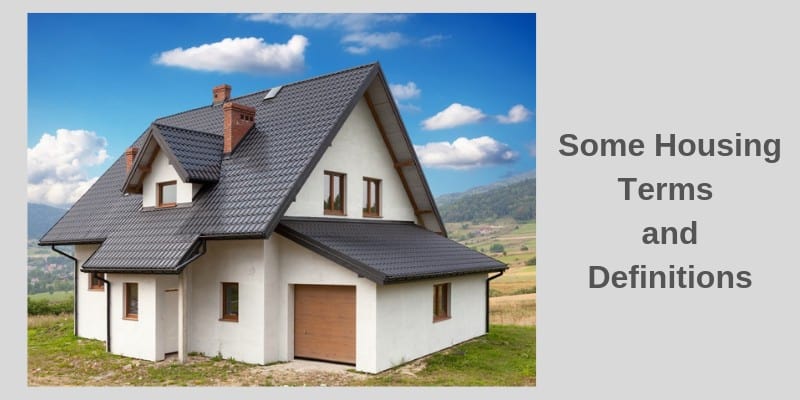
What is a detached house?
Over time, the single-family dwelling has become the epitome of style and the symbol of a family’s ability to afford a home on land rather than being trapped in neighborhoods where noise and overcrowding were once the norm.
The detached house typically sits on a tract of land that is larger than the home itself, but that is the only commonality shared by today’s detached housing options.
That stated, the detached house continues to be “the American dream,” though types of single-family homes have grown exponentially over time. These are just a few of the options today’s family has when searching for unattached housing:
- Small, unattached cottages usually feature a central corridor with four main rooms.
- Bungalows are stand-alone dwellings that often have have open floor plans.
- Raised ranch houses divide interior space between ground and elevated sections.
- The tiny home phenomenon has produced a style that rarely exceeds 400 square feet in size.
- The manufactured home is a pre-fabricated, one-level house categorized with trailers.
- Villas are classified as large, comfortably-sized houses with multiple bedrooms and baths.
- The mansion offers expansive living space, sprawling lawns and specialty rooms like libraries.
But there’s a price to pay for moving into a detached home. Responsibility for yard upkeep may not be a disadvantage to homeowners who love gardening, but without benefit of homeowner’s associations that govern multi-family communities, additional expenses involved with upkeep and repair usually fall to the family living in a detached house.
What is a HUD home?
Before it was organized as an agency that became part of every U.S. president’s cabinet, the Housing and Urban Development Act of 1937 gave the government oversight on properties and programs designed to help disadvantaged people unable to buy or rent homes due to their financial situations.
The objective of HUD is to create policy and programs that improve and develop communities while enforcing fair housing laws. Among the functions of this branch of government are:
- Issuing mortgage insurance to low-income families qualified to purchase homes
- Rehabilitating and modernizing public housing projects, particularly in inner cities
- Developing multi-family communities that are HUD-insured
- Enforcing Federal Fair Housing laws and other legislation
- Assisting low-income families purchase affordable housing via rent subsidies
- Working to improve and revitalize urban centers and neighborhoods
- Overseeing Native American housing “stock” to make sure standards are maintained.
Because this program is administered by the federal government, HUD is particularly cautious about awarding HUD contracts, facilitated by HUD’s Chief Procurement Officer (CPO) headquartered in the nation’s capital.
There are Field Contracting Operations (FCOs) sites located in Philadelphia, PA, Atlanta, GA and Denver, CO, plus smaller branches of the agency that provide resource assistance in and around large cities.
According to PocketSense.com, HUD provides irreplaceable assistance to members of society who are disadvantaged, elderly and impoverished.
To qualify for these services and placement in a single-family home, condominium or other style of housing that’s under the HUD purview, a consumer must prove that she not only needs subsidized housing but can prove that her income doesn’t exceed 80-percent of the community’s median income. Only those who survive a rigorous background check are eligible to apply for HUD benefits.
What is a keeping room in a house?
The keeping room was an essential part of 18th Century America because it was the epicenter of the home’s heating system.
This multi-purpose area served many purposes, including being the place cooking stoves and fires kept temperatures bearable. Over time, cooks complained bitterly about so much humanity packed into small spaces, so architects began to add “keeping rooms” to floor plans that kept the kitchen crowd-free.
Around 246 years have passed since homes included dedicated keeping rooms, say editors at HouseBeautiful.com, and the concept has changed so radically, Colonial homemakers would be hard-pressed to identify today’s versions.
For some home developers, the keeping room refers to any space that features a fireplace. Real estate professionals have expanded that definition to any space that accommodates the entire family, so the category has endless possibilities.
What fits under the umbrella of the keeping room in today’s society? Just about anything a homeowner desires, as long as there’s enough room for people to hang out and there’s a heating source to keep the room temperate.
If the epicenter of a family’s life happens to revolve around a home-based business, it’s not unusual to categorize it as a keeping room, especially if there’s a fireplace to heat the room and all family members use the space for their own interests.
With or without a fireplace, the 21st Century den or home office isn’t the only space that beckons family. Entertainment centers loaded with technology and comfortable seating can easily become a latter-day keeping room.
In the end, the keeping room has morphed from a place family gathers to stay warm to a place family gathers to share warm memories! Whether the room design is traditional or modern, the spirit of the keeping room will be kept alive as long as families prioritize a location within the home where everyone in the household is welcome.
What is a patio home?
New York State real estate broker Joe Sorrentino knows a thing or two about patio homes because he sells them. His biggest complaint? Semantics. Many people are confused about the definition of a patio home, regularly referring to them as condos and townhouses.
It’s easy to see how home shoppers can become confused because patio houses look and behave like attached housing but that’s not necessarily true. Patio homes can be attached or stand-alone houses that give developers more layout possibilities.
Given the fluidity of this type of house, even zoning gets confusing. Some communities classify them as cluster developments while others classify them as condos or townhouses. And of course, every dwelling has its own patio.
Fortunately, there are some descriptors that can help you identify a patio home. Lots tend to be smaller. Units are constructed closer together and, in some cases, due to design parameters, they are situated closer to the road.
Patio homes are usually single-story designs, though once again, developers continually spread their creative wings, just as long as they can fit their properties into a community’s zoning categories.
Will home shoppers always find patio homes called by their real name? Not necessarily. In some areas of the country, they are called “cluster homes.” Community developers and real estate professionals may also refer to them as twin homes, carriage homes and garden homes, using these terms interchangeably and generically.
Have we confused you? Imagine how home buyers and developers feel when trying to acquire property within a municipal government’s confusing list of home style definitions.
While every state’s housing laws are different, there is one quirky fact associated with patio homes and it’s uniform across the country: Taxing jurisdictions rarely show a separate classification for patio homes. Don’t fret. You’ll have a patio. That’s a guarantee, whether your community calls itself a gathering of town homes, condos or patio homes.
Resources
https://en.wikipedia.org/wiki/Single-family_detached_home
https://www.hud.gov/about/hud_history
https://www.hud.gov/program_offices/sdb/guide/general
https://pocketsense.com/qualifies-hud-housing-2871.html
https://www.housebeautiful.com/design-inspiration/news/a8010/keeping-room-trend/
https://en.wikipedia.org/wiki/Patio_home
Related Posts
- 14 Types of Sofa Cushions – Filling Material and Style Guide
- How to Stop Sliding Doors from Rattling – Causes and Solutions
- Cheap Ways to Heat a Room – Efficient and Budget-Friendly Solutions
- 11 Ways to Get Rid of Cooking Smells in a Small Apartment or House
- 11 Stores and Sites Like IKEA For Affordable Furniture and Home Products
- All About Polypropylene – Olefin Fabric Sofa Material

Leave a Reply